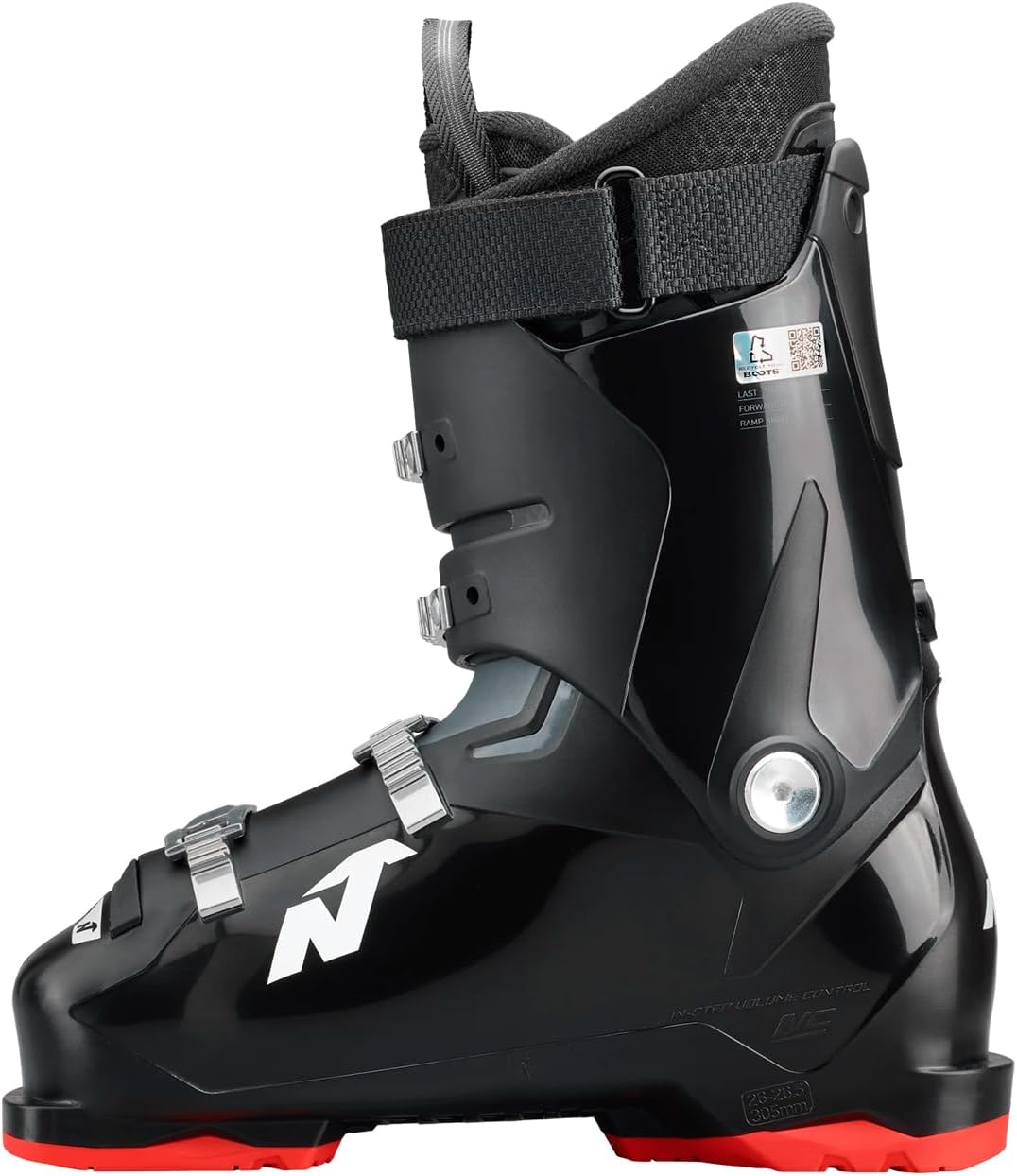
If you’ve ever rented ski boots and spent the day fighting your skis — feeling like they had a mind of their own, your shins bruising by noon, your heels lifting on every turn — the problem almost certainly wasn’t your technique. It was your boots. Ski boots are the single most important piece of equipment in your setup, because they are the only physical link between your body and your skis. Every signal your legs send to the snow travels through the boot. When the boot fits wrong or has the wrong stiffness rating, those signals arrive garbled. Two numbers define most of what “wrong” means: flex index (a rating, usually 60–130, that describes how stiff the boot’s shell is — how hard you have to push to make it bend forward) and last width (measured in millimeters at the widest point of the boot’s interior, which determines whether the boot wraps your foot snugly or leaves it swimming). Get both right and your skiing opens up. Get either one wrong and you’re managing the boot instead of skiing.
This article is for riders who have a season or two under their belt, understand that boot fit matters, but are staring at a wall of options and genuinely unsure what the numbers mean for their skiing, their foot, and their home mountain. We’ll break down both variables with clear decision rules — including the tradeoffs nobody mentions at the shop counter.
Flex Index: What the Number Actually Tells You (and What It Doesn’t)
The flex index is printed on virtually every ski boot sold at retail. A number like “100 flex” or “120 flex” describes how much force is required to move the boot’s cuff forward. Higher number = stiffer boot = more direct energy transfer = more demanding to ski. Lower number = softer boot = more forgiving = less precise at speed.
Here’s the thing the number doesn’t tell you: flex ratings are not standardized across brands. A Lange RS 110 and a Salomon S/Pro 110 are both labeled “110 flex,” but reviewers at SkiMag.com consistently note they ski at meaningfully different stiffness levels. Lange’s shells tend to run stiffer for a given number; some boutique-leaning brands like Full Tilt (known for their walk-mode hinge system) skew softer. The number is a useful internal comparison within a brand’s lineup, but cross-brand flex comparisons require reading aggregated review data rather than trusting the label alone.
The practical decision frame:
| Rider Profile | Flex Range to Consider |
|---|---|
| True beginner, mostly green/blue runs | 60–80 |
| Progressing intermediate, blues and easy blacks | 80–100 |
| Strong intermediate to advanced, varied terrain | 100–120 |
| Expert / aggressive charger, firm snow or big terrain | 120–130+ |
Per Outside Online’s how-to-buy-ski-boots guide, the most common mistake intermediate riders make is buying a boot that’s too stiff — convinced that stiffer means better, when in reality a boot you can’t flex properly keeps you sitting back and fatiguing your legs. The second most common mistake is buying one that’s too soft — assuming a beginner-spec flex will be more comfortable, only to find it bags out within a season and offers no rebound when you actually need to drive a turn.
Weight matters more than most guides acknowledge. A 140-pound skier and a 210-pound skier applying the same muscular effort will flex the same boot very differently. Powder.com’s editorial feature “Why Your Boots Are Holding You Back” flags this explicitly: lighter riders often ski a stiffer boot than their ability level suggests on paper, because their body weight alone isn’t sufficient to load the boot — they need the extra muscular engagement. Heavier riders may find that a “90 flex” boot feels like cardboard by the end of a hard day, even if they’re skiing intermediate terrain.
Cold weather stiffens every boot. A 100-flex boot on a 15°F morning at Alta behaves closer to a 115-flex boot until it warms up from body heat and exertion. If you’re skiing cold, dry Wasatch conditions consistently, skew one step softer than you think you need. Coastal BC skiing — warmer, wetter snow, more variable temps — keeps boots closer to their rated flex throughout the day.
Last Width: The Measurement That Makes or Breaks Long-Term Comfort
Last width is the interior width of the boot shell measured at the widest point of the forefoot, expressed in millimeters. Most resort ski boots fall into three broad categories:
- Narrow last: 97–99 mm — designed for feet with a low volume profile, slim heel, and narrow forefoot. Common in performance race-leaning boots.
- Medium last: 100–102 mm — the industry workhorse. Fits a wide range of foot shapes.
- Wide last: 103–106 mm+ — built for genuinely wide feet, high insteps, or riders with bunions or wide metatarsals.
The Freeskier.com annual boot review roundup (2025–26 edition) describes last width as “the variable that determines whether you’re skiing or just surviving.” That’s only a mild exaggeration. A boot that’s too narrow creates pressure points across the forefoot that build into numbness within 90 minutes — your foot is literally being compressed, restricting circulation. A boot that’s too wide allows the foot to shift laterally inside the shell, creating friction hot spots on the heel and reducing the precision of your edge engagement.
The liner complicates everything. Every ski boot ships with an interior liner — a removable, padded inner boot that sits between your foot and the hard plastic shell. Liners compress and pack out (gradually lose volume) over 10–20 ski days. A boot that feels comfortably snug on day one may feel sloppy by mid-January. This is why experienced boot fitters measure your foot against the shell, not the shell-with-liner, and why heat-moldable liners (standard on most mid-to-upper-tier boots like the Tecnica Mach1 or Fischer RC4 line) are worth the extra cost — they conform to your foot’s actual shape rather than requiring your foot to conform to a generic mold.
By the Numbers — Resort Boot Fit Reference:
- 97–99 mm last: fits roughly 20% of the skier population; common in Lange, Atomic Redster line
- 100–102 mm last: fits roughly 55–60% of skiers; Salomon S/Pro, Tecnica Mach1, Fischer RC4 Pro
- 103–106 mm last: fits roughly 20–25% of skiers; Nordica Strider series, Rossignol Pure Pro wide variants
- Heat-mold fitting sessions at specialty boot shops: typically $50–$100, often credited toward purchase
Source: aggregated spec data across manufacturer fit guides, cross-referenced with SkiMag.com boot buyer’s guide.
How Flex and Last Interact — and Why Getting One Right Isn’t Enough
Here’s the tradeoff that almost nobody explains clearly: flex and last width aren’t independent variables. A stiffer boot with a poor last-width match is more punishing than a softer boot with the same mismatch, because you’re driving more force into a contact point that’s already causing pain. Conversely, a wider-last boot in a lower flex often masks fit problems by allowing enough movement that the pressure points never quite get bad enough to notice — until year two, when the liner has packed out and suddenly your heel is lifting on every turn and you can’t understand why your skiing has regressed.
The practical rule from Powder.com and echoed consistently in the Freeskier.com roundup: nail the last width first, then select flex. If you’re between a 100 mm and 102 mm last option, try both shells (without liners if a good boot fitter will allow it) and feel where your forefoot contacts the plastic. A 2mm difference in last width is surprisingly significant. Once you’ve identified the shell that wraps your foot without pinching, then work up or down on flex based on your ability level and the weight/cold-weather adjustments described above.
The custom footbed question: Most ski boot performance guides — including Outside Online’s buyer’s guide and the SkiMag boot buyer’s feature — recommend a custom orthotic footbed as the single highest-return upgrade available to any skier. A stock boot footbed is a flat foam insert designed for the median foot. A custom footbed, typically $150–$250 from a specialty boot fitter, supports your arch and controls heel pronation (inward rolling), which directly affects how your ankle aligns inside the boot and how efficiently your flex effort translates to the ski’s edge. Owners who’ve made the switch consistently report that it changes a mediocre-fitting boot into a great-fitting one, and a great-fitting boot into something that feels like an extension of the leg.
The Decision Rule: If X, Then Y
If you’re heading into a boot purchase in the next 30–60 days, here’s the framework distilled to its simplest form:
If you ski 10–25 days per season on resort groomers and moderate off-piste, weigh 140–180 lbs, and ski aggressively on blues and casual blacks: target 95–105 flex, 100–102 mm last. This is the largest overlap zone in the market. The Salomon S/Pro HV 100, Tecnica Mach1 MV 100, and Fischer RC4 80 (slightly softer, good for the lower end of this weight range) all live here. See today’s best price on options in this range before committing to any one model.
If you ski 30+ days, charge hard on blacks and trees, and care about edge precision over all-day comfort: target 110–120 flex, 97–100 mm last. You want a snug, precise fit. Accept that the first few days will feel firm — the liner needs to break in. Lange XT3 110, Atomic Hawx Ultra 110, and Dalbello Lupo line are consistently cited in this performance tier by reviewers at both SkiMag.com and Freeskier.com.
If your feet are genuinely wide (you regularly buy shoes in wide sizes, or your forefoot width exceeds 100mm when traced): don’t compromise on last width to get a “better” brand or flex rating. Nordica’s Strider line and Rossignol’s wide-last variants exist for a reason. A perfect-fitting 100-flex boot will outperform a painful 120-flex boot every single day.
If you’re skiing Wasatch powder or cold-climate resorts predominantly: go one flex step softer than your ability level suggests on paper. The cold-stiffening effect is real, and a boot that’s marginally softer in the shop will be right on target at 7,000 feet in January.
One final note: no article — including this one — replaces 20 minutes with a skilled boot fitter who can actually look at your foot, measure your instep height, and assess your ankle flex range. The numbers here give you a framework to walk in informed and push back if the recommendation doesn’t match. That’s the goal. Walk in knowing what questions to ask, and you won’t walk out with the wrong boot.